
When “Safety” Becomes a Shield From Accountability
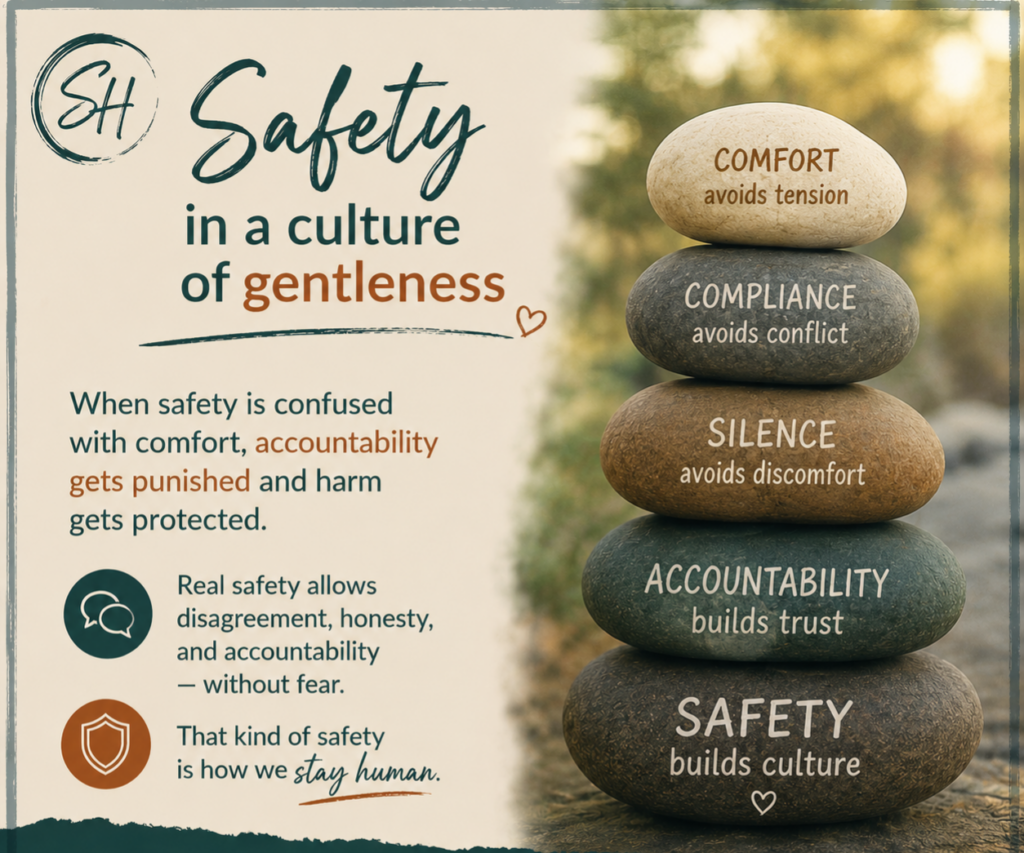
In relational cultures, the word safe matters deeply.
(This article may contain affiliate links. If you purchase through these links, Staying Human may earn a small commission at no additional cost to you. I only recommend products and services that I genuinely believe are valuable).
In a culture of gentleness, as per Gentle Teaching International, psychological safety is not a side concept. It is foundational. Human beings thrive when they experience safety, dignity, belonging, and meaningful engagement. Without safety, people mask, withdraw, appease, or fight for survival. The 4 pillars start with safety! Humans must feel Safe and Loved to be Loving and Engaged.
When new leaders or professionals come into an organization working to infuse Gentle Teaching, many have difficulty with the transition from the status quo hierarchical and patriarchal systems they were trained in. They may unintentionally confuse safety with comfort. That confusion can create serious problems within a relational culture.
A healthy relational culture rooted in a culture of gentleness must allow people to ask difficult questions, disagree respectfully, escalate concerns, identify harm, challenge decisions, and hold power accountable. If those things cannot happen safely, the culture is not psychologically safe. It is psychologically managed.
Real safety does not protect leaders from discomfort. It protects people from degradation, humiliation, retaliation, intimidation, exclusion, and abuse of power. When stakes are high, disagreement can feel like confrontation. Humans are emotional beings, and respectful disagreement doesn’t always mean emotionless. A leader feeling challenged is not the same thing as a leader being unsafe, and that distinction matters enormously.
One of the more concerning shifts happening in modern workplace culture is the tendency to treat emotional discomfort as evidence that harm has occurred. Discomfort, however, can arise for many reasons. A person may feel uncomfortable, and in their view, unsafe because they are being challenged, confronted with inconsistency, losing control of a narrative, experiencing accountability, or encountering someone unwilling to remain silent. None of those situations automatically indicate harm. All of them are opportunities for growth.
Sometimes people in positions of authority experience disagreement itself as threatening because they are accustomed to environments where leadership is insulated from challenge. In those systems, disagreement can quickly become reframed as disrespect, negativity, disloyalty, insubordination, or “making people feel unsafe.” This is one of the ways accountability becomes suppressed while leadership still appears relational on the surface.
A culture of gentleness was never intended to create environments where people quietly comply, avoid tension, and absorb harm in order to preserve superficial peace. A true GT culture must be strong enough to hold honesty, repair, feedback, conflict, and self-examination. Otherwise, the language of gentleness becomes performative rather than transformational.
If only certain people are allowed to speak honestly, the culture is not safe. If disagreement is punished selectively, the culture is not safe. If escalation is treated as betrayal, the culture is not safe. Leaders who surround themselves only with people who affirm them or avoid challenging them eventually create cultures that lose integrity, even while continuing to use the language of care and inclusion.
As Brené Brown teaches, “clear is kind.” Clarity reduces manipulation, resentment, hidden agendas, and passive aggression. Being clear does not mean being cruel. A person can speak directly while still protecting dignity.
In fact, many people who describe themselves as “nice” are not psychologically safe at all. They may avoid honesty, withhold concerns, triangulate behind the scenes, or silently enable dysfunction while maintaining a pleasant image. Kindness without honesty eventually becomes avoidance.
A mature understanding of safety asks more from all of us. It requires the ability to remain regulated during disagreement, tolerate feedback without retaliation, distinguish discomfort from danger, and hold power without requiring compliance in order to feel secure. It also requires enough humility to examine our own communication, assumptions, and blind spots while continuing to engage honestly.
Weak leadership often speaks about safety while struggling the most to tolerate it in practice, because accountability threatens fragile authority. Secure leaders do not require constant affirmation to maintain stability. They can tolerate disagreement without interpreting it as disloyalty or disrespect. Weak leadership, however, often pathologizes challenge itself. The issue ceases to be the concern that was raised and becomes the fact that someone dared to raise it at all.
This is how organizations slowly drift away from integrity while continuing to use the language of relational care. That is a dichotomy that causes confusion, and general low morale because people sense disharmony and incongruence even if they can’t or don’t articulate it.
Safety does not mean agreement, emotional comfort, protection from feedback, or freedom from challenge. Safety means dignity remains intact, truth can be spoken, power is handled responsibly, accountability is possible, and people do not have to betray themselves in order to belong.
That kind of safety is not fragile. It is strong enough to hold honesty.
Want to Learn More? Dive Deeper?
Are you interested in learning how to create a culture of gentleness in your workplace? The benefits are indisputable. Staff retention, job satisfaction, increased productivity are cornerstone to a healthy and safe workplace culture. Get in touch to learn more or let me know what’s on your mind!
Curious about how you align with your current organization?
Use our Culture Alignment tool to assess your fit. It is completely anonymous and always confidential – no email required to take the assessment. No one will reach out to you unless you choose to connect!
Are you ready to address your personal programming and become truly sovereign? Staying Human strongly recommends and endorses the Black Book of Power by Stan Taylor (not his real name). This is not a flowery feel good book. It is hard work that has the potential to transform readers into powerful sovereign and uniquely authentic individuals.
I could not agree more and coming from 2 perspectives, both the white and blue collar workers. My level of trust with authority was always based on my ability to speak open and honestly.